Green Screen vs. Cyc Wall: Which Do You Need for Your Next Shoot?
When you are planning a shoot or booking studio time, you will likely run into two terms that seem to offer the exact same thing: a green screen and a cyc wall (short for cyclorama). Both might simply look like massive, seamless backdrops. But understanding the difference between a green screen vs cyc wall is crucial, as they solve entirely different production problems.
The distinction is simple: a cyc wall gives you your final background right in the camera, while a green screen defers your background choice to the editing room. Let’s break down what each setup does, compare production trade-offs, and help you book the right space.
What is a Cyc Wall?
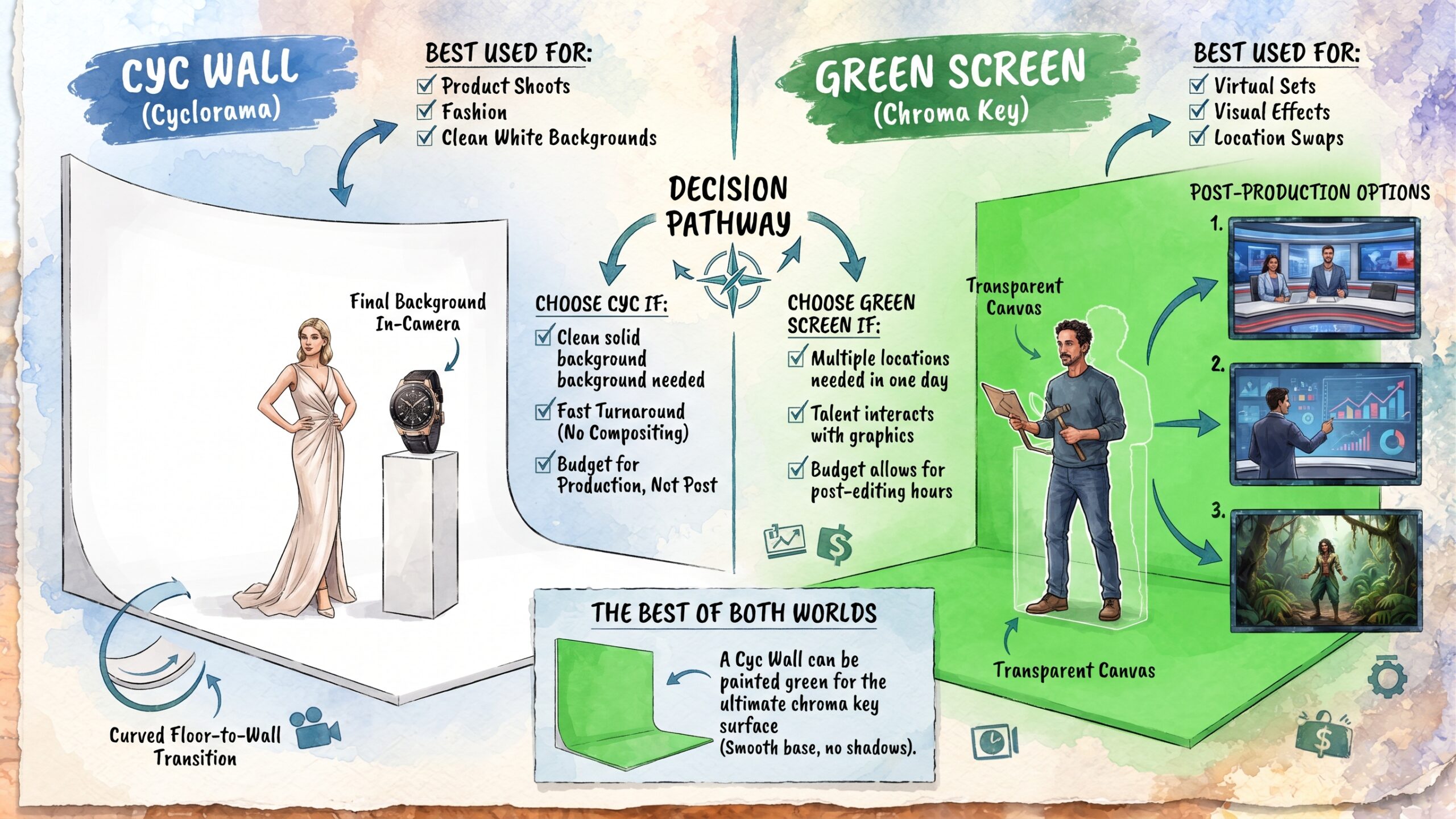
A cyclorama wall—often referred to as an infinity wall or simply a cyc—is a solid surface featuring a curved floor-to-wall transition. This sweeping curve eliminates any visible corners, creating the illusion of infinite space.
What is a cyc wall best used for? It is the industry standard for delivering a finished look straight out of the camera. While most studios feature a white cyc wall for pristine Commercial Shoots highlighting products on white, it can be painted or lit to match almost any color. Because the background you shoot is the exact background you keep, it requires zero compositing. You light it, shoot it, and you are done.
What is a Green Screen?
A green screen is a flat, brightly colored surface designed specifically for a visual effects technique called chroma keying. Unlike a cyc wall, a green screen is never meant to be seen in the final video.
Instead, specialized software identifies that specific shade of green and removes it entirely, making the background transparent. This allows editors to place the subject in a completely different environment. Whether you are dropping a presenter in front of animated slides, building a virtual set, or placing actors in a location you cannot physically access, a green screen gives you infinite flexibility after the cameras stop rolling.
Cyc Wall vs. Green Screen: Comparing the Trade-Offs
To decide between a cyclorama vs green screen, you must weigh your timeline against your creative needs. A portable green screen can look cheaper initially, but it introduces hidden costs. Every minute of footage requires compositing. If lighting is uneven, you risk “green spill”—where green light reflects onto your subject—leading to hours of corrective editing.
For productions that simply need a solid backdrop, a cyc wall is usually faster and more cost-effective because it eliminates those recurring Editing & Post-Production hours.
Quick Comparison Table
Feature Cyc Wall Green Screen Primary Function Provides the final in-camera background Provides a transparent canvas for post-production Visual Setup Curved floor-to-wall transition Flat, keyable colored surface Post-Production None (ready out of camera) Required (background replacement) Cost Pattern Fixed studio rental cost Adds recurring editing hours Best Used For Product shoots, fashion, clean backgrounds Virtual sets, visual effects, location swaps Decision Cheat-Sheet: Which Should You Book?
Still unsure which setup fits your project? Use this practical guide:
Book a cyc wall if:
- You want a clean white or solid-colored background as your final look.
- You have a fast turnaround time and need to skip heavy editing.
- Your budget is better spent on production rather than post-production fixes.
- You are shooting fashion, corporate headshots, or physical products.
Book a green screen if:
- You need your subject to appear in a different location or virtual set.
- You are placing complex graphics or slides behind a speaker.
- You are incorporating visual effects where talent interacts with digital elements.
- You need to capture multiple distinct background looks from one shooting day.
Why a Cyc Wall Makes the Best Green Screen
Here is the secret that bridges the gap: a cyc wall can actually be painted green, making it the absolute best surface for chroma keying. Its curved base removes the hard shadow line where a traditional wall meets the floor, creating the smooth backdrop that editing software loves.
But whether using a white cyc or a green screen, success requires even lighting. A cyc isn’t automatically a glowing infinity cove, and a green screen keys poorly without proper illumination.
This is why relying on a professional facility matters. Trying to improvise these setups in a conference room usually results in frustrating shadows. Drake Media Studios is a working broadcast facility—not just a rental space. With an 8,200-square-foot studio serving the New York metro area and Long Island, you gain access to a professional lighting grid and a team with real TV experience who knows how to light for successful Film & TV Production.
Whether you need the flawless perfection of a cyclorama wall or the digital flexibility of a green screen, starting with a proper Studio Rental ensures your project looks professional. Discover our full capabilities at The Studio.
Frequently Asked Questions
Q: What’s the difference between a cyc wall and a green screen? A: A cyc wall is a curved, seamless surface that gives you a clean background — usually white — straight out of camera, no editing required. A green screen is a flat green surface whose background gets replaced in post with a different environment.
Q: What is a cyclorama (cyc) wall? A: A cyclorama, cyc wall, or infinity wall is a curved wall-to-floor surface with no visible corner, creating the illusion of infinite space. It’s the standard for product, fashion, headshots, and clean-background video.
Q: Which do I need — a cyc wall or a green screen? A: Use a cyc wall when a clean white or colored background is the final look. Use a green screen when you need to place your subject somewhere else — a virtual set, a different location, or a scene with visual effects.
Q: Is a green screen cheaper than a cyc wall? A: It can look cheaper up front, but green screen adds post-production time to replace the background on every project. For clean-background work, a cyc wall is usually faster and cheaper overall because it needs no compositing.
Q: Can you use a cyc wall as a green screen? A: Yes. A cyc can be painted or draped green, and its curved base is actually ideal for green screen because it removes the hard shadow line where the wall meets the floor. A studio with a cyc can often do both.
Q: Does a cyc wall have to be white? A: No. White is the most common because it’s the most versatile, but a cyc can be lit or painted other colors to match the look you’re after.