How to Get Your Videos Seen: The Complete Guide to Video Content Distribution Strategy
You have just wrapped a phenomenal video shoot. The lighting was perfect, the messaging was sharp, and the editing tells a compelling story. You upload the final file, write a thoughtful caption, hit publish across your social media channels, and wait for the response.
Then, nothing happens.
If you are a business owner, marketing professional, or content creator, this is a familiar and deeply frustrating scenario. You are putting genuine effort into producing high-quality video content, yet when you share it with the world, it seems to vanish into the void. It is completely natural to ask yourself, “Why is no one seeing my videos?”
The immediate instinct for most creators and brands is to assume the problem lies in the volume of their output. The natural reaction is to grind harder, produce more content, and post more frequently in hopes of finally appeasing the algorithm. But in today’s digital landscape, posting and being seen are no longer the same thing. A single underperforming post is not a stroke of bad luck—it is the default reality in 2026.
The data makes this undeniable. Organic reach across major social media platforms has cratered. Today, average engagement runs around 0.15% on Facebook and 0.48% on Instagram. When you look at the historical timeline, Facebook’s organic reach has fallen roughly 86% over twelve years. Even on historically business-friendly platforms, the tide has turned; on LinkedIn, a large majority of users now report flat or declining reach with views down about half.
These numbers are not meant to discourage you. They are meant to validate your experience and reframe your approach. The problem is not your content, and the solution is not blindly creating more of it. What separates content that travels from content that disappears is a deliberate, systematic video content distribution strategy.
Reversing the Equation: The 20/80 Rule of Content Creation
When you understand that platforms actively restrict organic reach to prioritize paid advertising and keep users on their own applications, your entire approach to video production must evolve. You can no longer rely on a platform’s algorithm to do the heavy lifting of finding your audience. You have to build the roads that lead the audience to your content.
This requires a fundamental shift in how you allocate your time, budget, and energy. The professionals who successfully navigate today’s media landscape treat distribution as the primary job. A widely cited rule of thumb, popularized by entrepreneur Noah Kagan, is to spend 20% of your time creating content and 80% of your time distributing it.
Think about what that looks like in practice. If you spend ten hours planning, shooting, and editing a flagship video, you should be dedicating forty hours to ensuring that video reaches its intended audience. Most organizations have this ratio completely inverted. They exhaust their resources on production and leave distribution as an afterthought—a quick checklist of cross-posting to social media platforms before moving on to the next project.
To understand how to promote video content effectively, you have to transition from a mindset of “hope” to a mindset of “leverage.” You must actively push your content through a variety of distribution channels, tailoring the format and message to fit the unique expectations of each space. This is the essence of video content distribution: taking control of your reach rather than leaving it to chance.
What Exactly Is a Content Distribution Strategy?
A content distribution strategy is a comprehensive, documented plan for getting your content in front of your target audience across various channels and platforms. It details exactly how a single piece of media will be shared, repurposed, and amplified after the initial publication.
Without a distribution strategy, your video is simply a file sitting on a server. With a strategy, that same video becomes the fuel for a multi-channel content marketing engine. An effective strategy answers several critical questions:
- Where does our target audience actually spend their time?
- What format do they prefer to consume when they are on those specific platforms?
- How can we get this core message in front of them repeatedly without appearing repetitive?
- What resources (time, money, partnerships) will we use to amplify this message?
Building this strategy requires moving away from the idea that one video equals one post. Instead, you must view every piece of high-value video content as a primary asset that can be broken down, reshaped, and deployed across an entire ecosystem of media channels.
The Strategic Backbone: Owned, Earned, and Paid Media
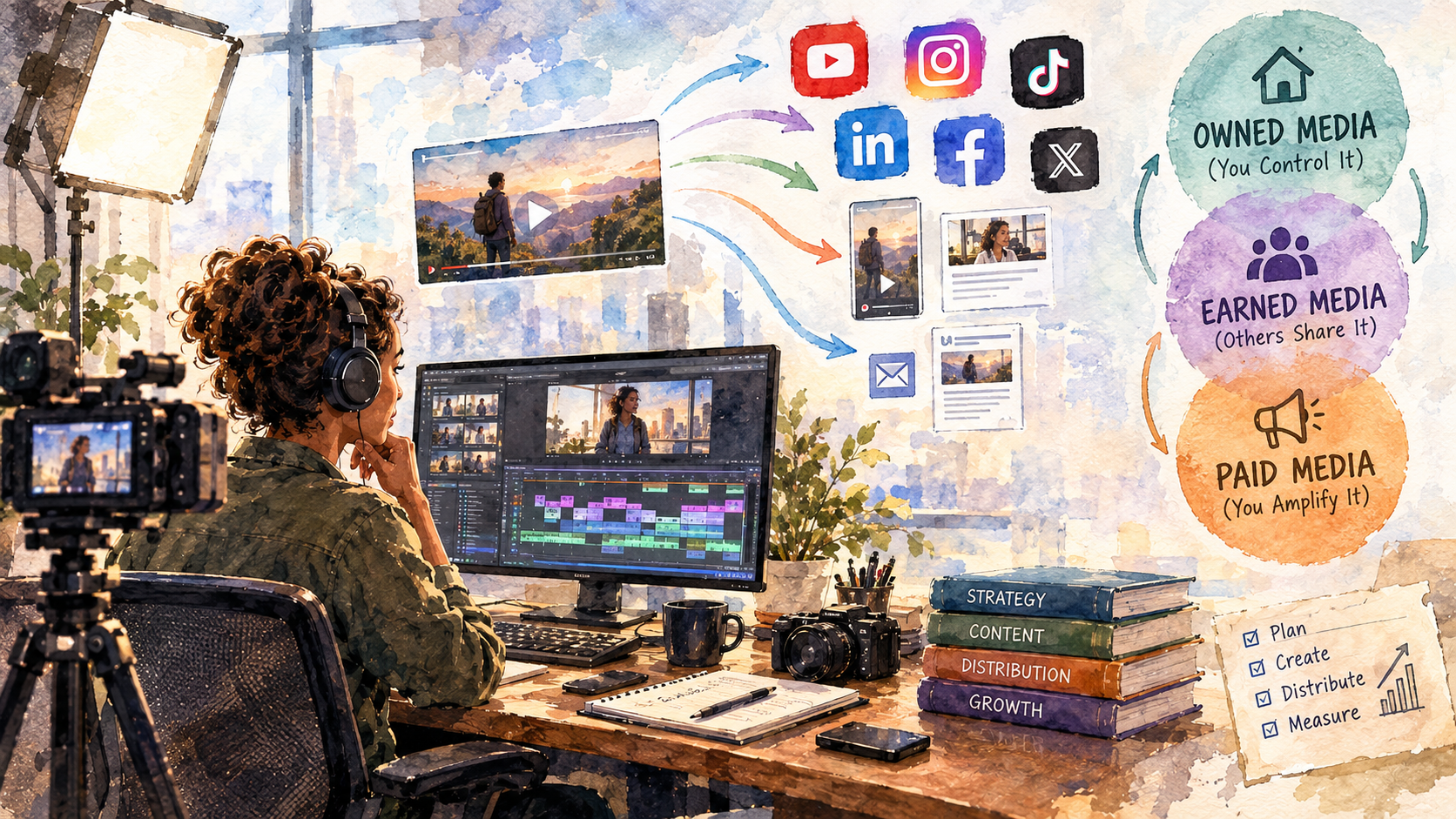
To bring structure to your content distribution efforts, you need a reliable framework. The most effective content marketing strategy is built upon the classic Owned, Earned, and Paid (OEP) media model. Understanding how these three pillars interact is the key to maximizing your reach and return on investment.
Owned Media: Channels You Control
Owned media refers to the distribution channels that belong to you or your organization. You control the messaging, the timing, and the user experience. You do not have to worry about an algorithm suddenly hiding your content or a platform changing its rules overnight.
Owned channels are the safest and most reliable places to house your content. They include your company website, your landing pages, your blog posts, and most importantly, your email subscriber list. In a successful distribution strategy, owned media serves as the ultimate destination. The goal of your other channels is frequently to drive traffic back to these owned properties where you can build a direct, uninterrupted relationship with your audience.
Earned Media: Exposure You Gain
Earned media is the exposure you receive through word-of-mouth, third-party validation, and community sharing. You cannot buy it, and you do not own it—you have to earn it by creating high-quality content that naturally resonates with others.
This includes user-generated content, shares and retweets, mentions by industry influencers, press coverage, and guest features on other platforms. Earned media is incredibly powerful because it acts as social proof. When someone else shares your video, they are essentially endorsing your message to their own audience, which builds trust far faster than self-promotion.
Paid Media: Amplification You Buy
Paid media is exactly what it sounds like: paying for placement and reach. This includes social media ads, boosted social media posts, pay-per-click (PPC) campaigns on a search engine, and sponsored placements in industry newsletters.
While organic reach is declining, paid media offers guaranteed visibility. You can precisely target your ideal audience based on demographics, interests, and behaviors. However, paid media works best when it is used to amplify content that has already proven to be effective organically. It is the fuel you pour onto a fire that is already burning.
The strongest content distribution platforms and strategies do not rely on just one of these pillars; they weave all three together. You host the video on your owned channels, you seed it to generate earned media, and you use paid media to scale its success.
Owned Media in Action: Building Your Algorithm-Proof Engine
If you want to stop worrying about why your videos are not being seen on social media, you need to invest heavily in the channels where social media algorithms do not exist.
Your email newsletter is arguably your most valuable distribution asset. It is a direct line to an audience that has explicitly asked to hear from you. When you send an email, it lands in the inbox. It does not get suppressed because it lacked a trending audio track or the right hashtags. To use email for video content distribution, do not simply drop a raw link into a blank message. Provide context. Write a compelling summary of the video’s value, pull out an intriguing quote, and use an eye-catching thumbnail image equipped with a clear play button that links directly to the video on your website.
Your website and blog posts are equally critical. Search engine optimization (SEO) is a powerful, long-term distribution channel. By embedding your video content into relevant, high-value blog posts, you create a rich multimedia experience that keeps visitors on your site longer—a key metric search engines use to rank pages. Furthermore, transcribing your videos and turning the core concepts into written articles ensures that your content can be discovered by people searching for text-based answers.
When you anchor your video distribution in owned media, you build an asset that compounds in value over time, rather than a social media post that disappears from feeds within 48 hours.
The Hero Tactic: Mastering Video Repurposing
If there is a single, highest-leverage tactic in modern content distribution, it is repurposing. Repurposing is the process of reshaping one strong, foundational asset into many platform-ready pieces. This is how you multiply your reach severalfold while dramatically lowering your cost per piece. It is how you execute the 20/80 rule effectively, allowing one initial shoot to fuel your distribution channels for weeks.
Imagine you have just completed a comprehensive, high-quality production—perhaps a documentary-style brand story, a detailed client case study, or a professional commercial. You can learn more about producing these foundational assets through our Film & TV Production services, where one professional shoot is designed to yield multiple usable assets.
If you take that single 10-minute master video and simply upload it to YouTube, you have one touchpoint. But if you deploy a repurposing strategy, that same video becomes an entire campaign:
- The Master Video: Uploaded to YouTube and embedded on your landing pages.
- Audio Extraction: The audio track is polished and released as a podcast episode.
- Short-Form Vertical Clips: The best 30-to-60-second moments are cut vertically for TikTok, Instagram Reels, and YouTube Shorts.
- Text-Based Social Posts: Key insights and statistics from the video are turned into text posts for LinkedIn and X (formerly Twitter).
- Image Assets: High-resolution stills and behind-the-scenes photos are paired with quotes from the video for Instagram carousels.
- Written Content: The transcript is transformed into a comprehensive blog post and a dedicated email newsletter.
Suddenly, one video shoot has generated fifteen to twenty unique pieces of content. You are no longer scrambling to figure out what to post next week; your distribution strategy has already provided the roadmap.
This approach is particularly potent with episodic content. If you are recording long-form interviews or shows, you are sitting on a goldmine of repurposable material. Our Podcast & Vodcasting infrastructure is built exactly for this workflow—allowing creators to record once in a broadcast-quality environment and easily clip that master file into dozens of high-performing distribution assets.
Platform-Native Formats: Respecting the Channel
While repurposing is the engine of distribution, the execution requires nuance. The biggest mistake creators make when repurposing video is treating every platform like a generic dumping ground. They take a wide, horizontal video, shrink it down, leave black bars on the top and bottom, and upload it to TikTok.
That approach fails because it ignores the context of the platform. To get your videos seen, the format must be native to the channel. A Reel should look and feel like a Reel, not like a cropped television commercial.
When distributing across social media platforms, respect the user experience of each specific channel:
- Short-Form Video-Sharing Platforms (TikTok, Reels, Shorts): These require vertical framing (9:16 aspect ratio). The pacing must be incredibly fast, with the core hook delivered in the first three seconds. On-screen captions are mandatory, as a massive percentage of users watch with the sound off.
- LinkedIn: This audience values actionable insights, professional growth, and industry case studies. Videos here should be professional, clearly subtitled, and accompanied by a thoughtful, long-form text caption that summarizes the takeaway.
- YouTube: As the world’s second-largest search engine, YouTube rewards high-quality, long-form content with custom, high-contrast thumbnails and meticulously optimized titles and descriptions.
If your video feels out of place on a platform, users will scroll past it immediately. Content distribution is not about forcing your preferred format onto an audience; it is about adapting your message to fit the environment where the audience already comfortably resides.
Earned Media, Community Seeding, and Content Syndication
Once your owned channels are populated and your social media clips are natively formatted, you must actively push your content outward. This is where earned media and community seeding come into play.
Do not wait for people to magically stumble upon your video. Share it in highly relevant, niche communities. If you have produced a comprehensive guide to local real estate trends, share it in local community Facebook groups or targeted Reddit communities. The key to community seeding is to lead with value, not a sales pitch. Provide a detailed summary of your video within the community post itself, offering the link only as a resource for those who want to dive deeper.
Another major strategy for extending reach far beyond your own followers is content syndication. Content syndication is the process of republishing or distributing your content through third-party platforms, networks, or media partners to reach their established audiences.
When your video is syndicated, it gains the credibility and visibility of the host platform. This is a primary way that professional shows and established brands rapidly scale their viewership. Instead of building an audience one subscriber at a time from scratch, syndication allows you to tap into massive, pre-existing viewership pools.
Paid Media: Amplifying What Works
With organic reach at historic lows, a complete video content distribution strategy will almost always include a paid media component. However, the rule for paid distribution is simple: never pay to promote a bad video.
Many businesses make the mistake of creating a video, seeing that it gets zero organic engagement, and then throwing money at it via boosted posts in a desperate attempt to force people to watch. If a video fails to resonate organically with your core audience, amplifying it to a broader audience will only result in wasted ad spend and poor click-through rates.
Instead, use your organic distribution as a testing ground. When you execute your repurposing strategy and post ten different clips across your social channels, monitor the analytics. Look for the top-performing piece—the one clip that naturally earns more views, comments, and shares than the rest.
That is your winner. That is the video you put your paid media budget behind. By boosting content that has already proven its value, you lower your cost-per-click, increase your conversion rates, and ensure that your paid distribution efforts yield a tangible return on investment.
How the Pros Do It: The 25-Country Standard
Executing a multi-channel, heavily repurposed, owned-earned-paid distribution strategy requires significant time, discipline, and expertise. It requires setting realistic expectations and understanding that true reach is about compounding gains over a quarter or two of consistent execution, not chasing overnight virality.
If this sounds like a massive undertaking, that is because it is. Distribution is a full-time job, and it is the exact discipline that separates local projects from global media properties.
At Drake Media Studios, we know this because we live it every single day. We are a working broadcast facility, not just a rental space. The same 8,200-square-foot studio where The Donna Drake Show is produced is available to you, fully staffed and ready to go. Over the past 17 years, The Donna Drake Show has utilized rigorous, professional distribution strategies to grow its audience to reach 25 countries across CBS and multiple streaming platforms. We have earned Telly Awards and a United Nations Global Citizenship honor not just because of the stories we tell, but because we know exactly how to ensure those stories are actually seen.
You do not have to manage this complex ecosystem alone. For business owners, creators, and agencies who understand the importance of distribution but would rather hand the execution off to industry veterans, we offer comprehensive Media Distribution services.
This is the “done-for-you” version of everything outlined in this guide. Our team handles the repurposing, the platform placement, the syndication, and the strategic rollout of your content. By partnering with a credentialed media brand, you gain access to the same distribution infrastructure that powers our own national broadcasts.
When you are ready to stop posting into the void and start building a real audience, we invite you to explore everything The Studio has to offer. Bring us your project, and let our team ensure your message reaches the audience it deserves.
Frequently Asked Questions
Why is no one seeing my videos?
Usually, the problem is not the content itself—it is the lack of a structured distribution strategy. Organic reach has fallen sharply across almost all major platforms over the last decade. Simply uploading a video and posting it once rarely gets much visibility because platforms prioritize paid content and accounts that keep users engaged natively. Content that actually spreads in today’s environment is deliberately repurposed, natively formatted, and actively pushed across multiple owned, earned, and paid channels.
What is a content distribution strategy?
It is a comprehensive plan for getting each piece of content in front of people across the channels you own, earn, and pay for, rather than just posting once and hoping for the best. A strong distribution strategy maps out exactly how a core video asset will be sliced, repurposed, and shared across newsletters, blogs, social media platforms, and third-party syndication networks. It gives every single video asset multiple shots at finding and resonating with its intended audience.
What is owned, earned, and paid media?
This is the foundational framework for content marketing:
- Owned media refers to the channels you completely control, such as your website, blog, and email newsletter list. These are algorithm-proof spaces.
- Earned media is the exposure that others give you organically, including user shares, mentions, press coverage, and community discussions.
- Paid media is the amplification you purchase, such as pay-per-click ads, sponsored newsletter placements, and boosted social media posts. The strongest and most effective strategies seamlessly integrate all three.
How do I repurpose video content?
Repurposing is about taking one strong, foundational video and reshaping it specifically for each unique channel. For example, you can take a 20-minute interview and extract the audio for podcast feeds. Then, edit the most engaging 45-second moments into vertical clips for Reels, TikTok, and Shorts. You can pull powerful quotes and high-quality stills for text-based social posts on LinkedIn, and transcribe the core insights to create a comprehensive segment for your email newsletter. By doing this, one single recording session can fuel weeks of high-quality content.
What is content syndication?
Content syndication is the practice of republishing or distributing your original content through other platforms, broadcast networks, or media partners in order to reach their established audiences. Instead of only relying on your own follower count, syndication allows you to tap into larger, existing viewerships. This is a major strategy that professional shows, brands, and networks use to extend their reach far beyond their own organic limits.
Do I have to do all of this myself?
Absolutely not. Executing a high-level distribution strategy requires dedicated time, specific technical skills, and platform knowledge. A professional media distribution partner can handle the complex processes of repurposing, formatting, strategic placement, and content syndication for you. This is the exact same discipline and infrastructure that helps our own broadcasts reach engaged audiences in dozens of countries, allowing you to focus on your business while we handle your reach.